SpotOn: A Roadmap One Person Can Finish
A solo founder's roadmap isn't a build schedule. It's a map of kill-gates: cheap checkpoints before the expensive stages, and permission to quit early.
On this page
I built backwards, realized it (last post), and only then did the thing I should have done first. I wrote the roadmap. But it wasn’t a build schedule. It was a map of the places where I’m allowed to quit.
That’s the core of a solo founder’s roadmap. It isn’t a plan to build everything. It’s a map of kill-gates. Cheap, decisive checkpoints sit before the expensive stages, and there you decide whether to keep going or stop. Its worth doesn’t live in a finish schedule. It lives in permission to quit early.
A solo founder can’t finish the normal roadmap
The normal path for a hardware product is long. Plan, validate, build, fund, manufacture, operate. A normal company puts people and money on each stage and runs them in series. One person can’t finish that as a straight line. Manufacturing and certification aren’t walls you clear with one person plus an AI.
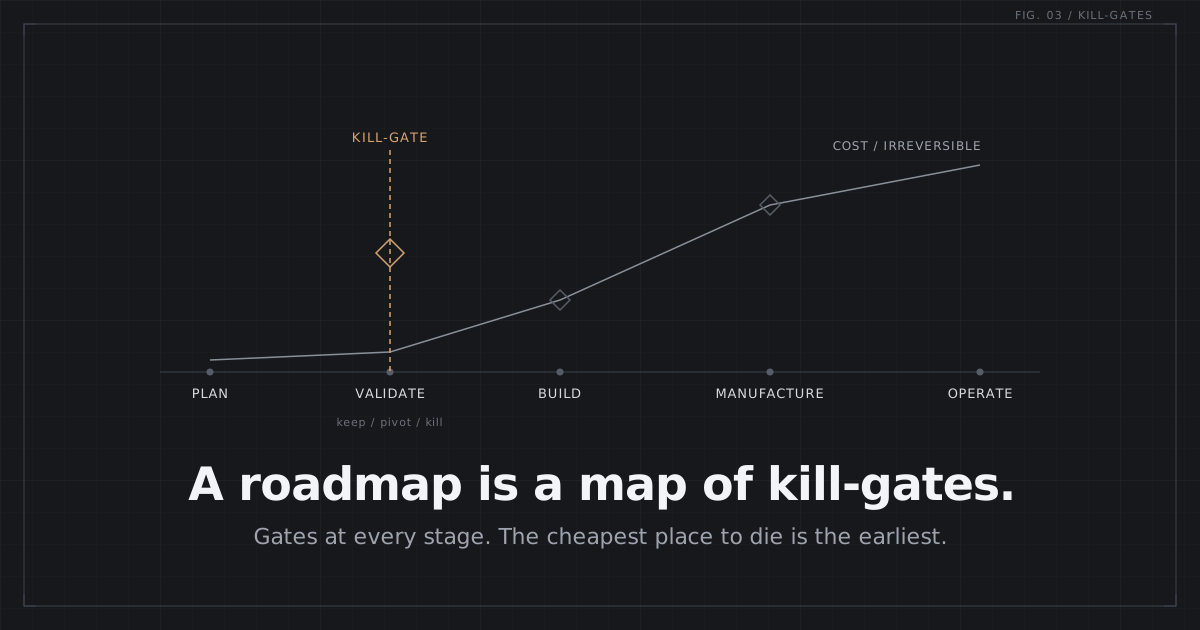
And the cost of each stage is wildly uneven. Planning is nearly free. Building burns time. Manufacturing is molds and certification, money you can’t claw back once it’s spent. Operating is a cost that never ends. When cost is this lopsided, what matters in a roadmap isn’t the stages themselves. It’s the space between them.
So you land in one of two places. It looks too big, so you never start. Or you skip to building without seeing the end. That was me. Both are the same mistake from two sides: reading the roadmap as a plan to finish.
This isn’t new: Stage-Gate
The idea already has a name. Stage-Gate, the standard new-product framework Robert Cooper laid out in 1988. You put a gate between stages and decide, on pre-set criteria, to Go, Kill, Hold, or Recycle. The point is to filter weak ideas out before they get expensive. What I called keep, pivot, or kill above is exactly Cooper’s Go, Recycle, Kill.
Stage-Gate was built for big companies, though. A portfolio tool: line up dozens of projects and filter which one gets budget. A solo founder has no portfolio to filter, no budget committee. And yet it matters more for one person. Here’s why.
Building got cheap. Build cost used to be the brake. Making things was expensive, so you stopped before building and asked “are we sure?” on your own. The AI harness pulled that brake off (last post). Once cost stops being a natural gate, you have to stand one up yourself. In a big company Stage-Gate smelled like bureaucracy. For a solo founder plus an AI, it stands in for a brake that’s gone.
Map the gates, not the stages
I redrew the roadmap from a list of stages into a list of gates.
One gate doesn’t cover it. There’s one at every boundary: end of validation, end of funding, right before manufacturing. Each gate asks the same question. Given what I’ve seen this far, keep going, pivot, or stop?
Cost climbs steeply as you move right, so the later the gate, the more expensive it is to die there. Fold at the earliest gate and you fold cheapest. In the end the map of gates is a map of where you can die cheaply.
A gate’s job is simple. Let a pre-committed bar make the call, not sunk cost. Write down “below this number, stop” before you enter the stage. Once you’re in, it’s too late. You wave it through because you’ve already poured so much in.
The cheapest gate before the most expensive stage
Put the most decisive gate right before the most expensive stage. For hardware that’s just ahead of manufacturing: molds and certification, the point where irreversible money goes out. I set two gates at that door.
First, demand. The bar can’t be a firmware question. It has to be “does a frustrated player pay for the coaching?” A real charge, not the survey’s “I’d buy it.” Second, technical. Does the signal survive in the real form factor, not on a lab board? That one only answers once you build a full-size development sample. Both have to pass before I put money into molds.
I pushed these gates behind the build. That’s what made it backwards (last post). Redrawn as a roadmap, it was obvious from the shape alone: they have to come before the build. Park the cheapest, most decisive questions at the door of the expensive stage. That’s how one person saves months and serious money.
Manufacturing and certification I can’t clear alone anyway. They need outside help and partners, the serial time of the physical world. The roadmap points out where that wall sits, in advance. The gate has to be alive before I reach it.
Where the map fails
A gate only works when I’m honest. People want to pass their own gate. The sunk cost stings, and your own idea looks pretty. So you nail down the bar that means “stop” early, cold, before the urge to pass shows up.
The harness makes this harder. When building gets cheap, gates get easy to skip too (the same trap as last post). Cheap building weakens the gate.
One last thing. A roadmap doesn’t know the future. The stage past the gate you just cleared can stay blurry. Don’t freeze trying to draw it all. Clear to the next gate is enough.
Wrapping up
Draw the gates before the stages. Decide what “stop” means before you enter, not after. Put the cheapest decisive gate before the most expensive stage.
The roadmap’s purpose isn’t to finish. Its purpose is permission to quit early. That permission is what keeps a solo founder alive.

Comments
Loading comments...